Design
Drag and drop on a board-aware canvas. Edit properties in the Inspector, apply themes, palettes, backgrounds and assets, then save your Hosted project.

ForgeUI Studio · ESP-IDF · LVGL 9
Design it. Connect it. Run it in real LVGL.
ForgeUI Studio is a visual LVGL UI builder for ESP32. Connect supported controls in the Inspector, run generated C with real LVGL 9.2.2 in your browser, then export or Build & Flash supported hardware.
Free for home & personal use. Business and commercial use is licensed separately. Supported browser and WebSerial-compatible hardware are required for device connection.
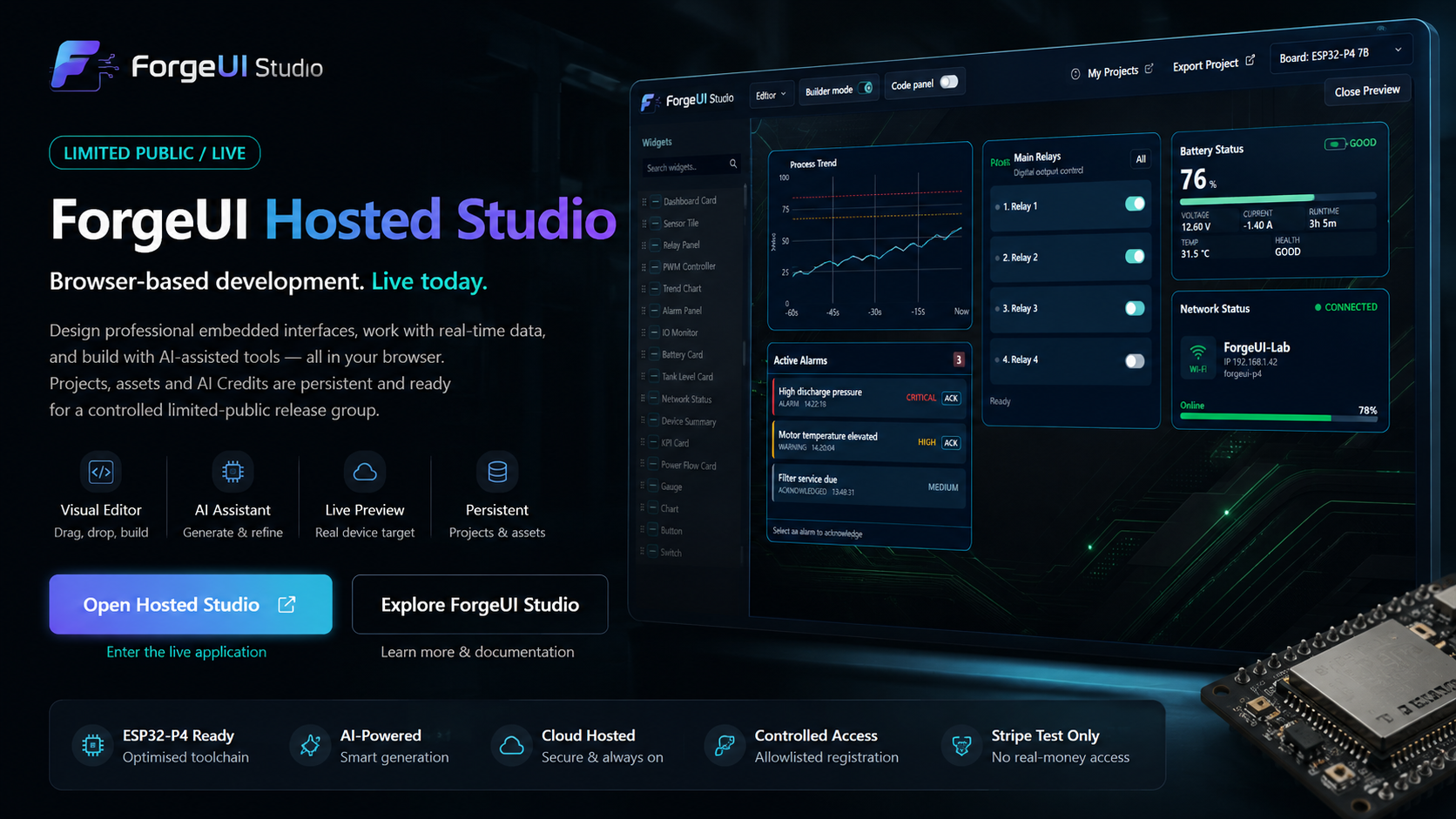
ForgeUI brings visual embedded UI and HMI development to ESP32, including supported ESP32-P4 and ESP32-S3 hardware. ForgeUI Hosted Studio turns LVGL 9 designs into native LVGL C for browser simulation, ESP-IDF builds and browser flashing where supported. You can also export a standalone ESP-IDF firmware project and continue development with your own toolchain.
LVGL Simulator · Live in Hosted Studio
Run your generated LVGL interface before connecting the board. ForgeUI compiles generated C with real LVGL 9.2.2 to WebAssembly, so you can inspect native controls and navigation with browser pointer interaction.
Drag and drop on a board-aware canvas. Edit properties in the Inspector, apply themes, palettes, backgrounds and assets, then save your Hosted project.
Connect supported controls in the Inspector without hand-writing callback plumbing, then interact with the generated interface in real LVGL.
Build ESP-IDF firmware and flash a supported ESP32 board using browser Web Serial. Verify hardware behaviour on the physical target.
Hosted Sim runs generated, data-only display projects and preserves saved firmware hardware settings. Developer-owned Hybrid C, hardware services and application logic run through exported firmware or Build & Flash on the target. Generated component setters connect sensors, CAN, UART, ADC and application state to the UI.
Design · Bind · Simulate
Connect a supported Slider to an RPM Gauge from the Inspector, then drag the real LVGL Slider in the browser. The generated binding updates the gauge value and needle live.
For sensors, ADC, CAN, UART and application state, generated component setters provide the bridge from developer-owned application code into the interface.
One connected browser workflow
Display projects use the complete path. Headless projects start in Code and use the same build, flash and Serial pipeline.
Display: Design → Simulate LVGL → Build & Flash → Real hardware
Headless: Code → Build → Flash → Serial
Visual design + real source
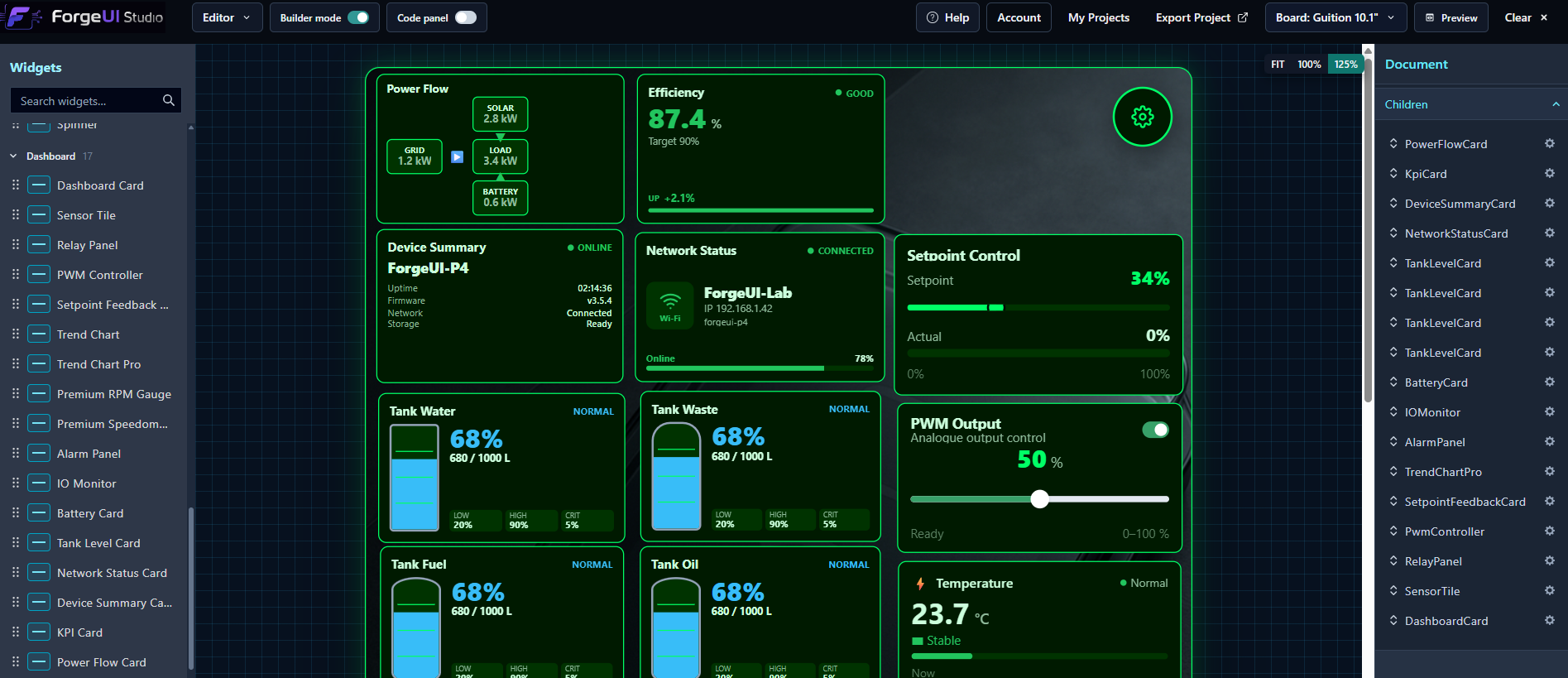
Drag and drop onto a board-sized Canvas, adjust geometry and appearance in the Inspector, fit or zoom, then check the result in Browser Preview. Generate native LVGL 9 instead of rebuilding the interface by hand in C.
Dashboard Card, Sensor Tile, Relay Panel, PWM Controller, Setpoint Feedback, Trend Chart, Trend Chart Pro, Alarm Panel, IO Monitor, Battery Card, Tank Level Card, Network Status, Device Summary, KPI and Power Flow.
Explore native and dashboard components →UI Library →Work with an actual file tree, multiple tabs and editable user-owned C source. Generated files stay protected; Rewind, compiler Problems and diagnostic-to-source navigation keep changes understandable.
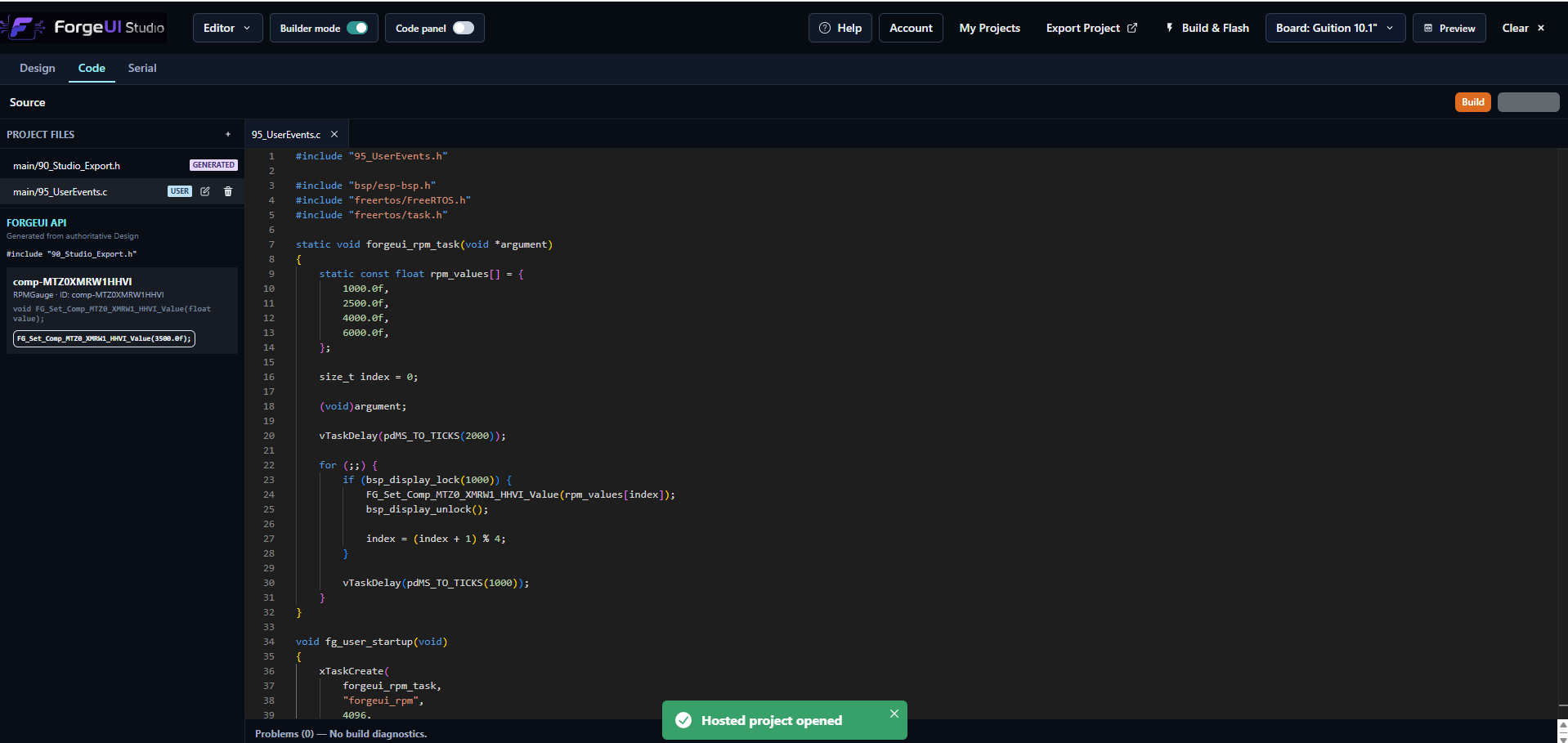
Drop an RPM Gauge, let ForgeUI generate its firmware API, then write the behaviour in user-owned code. Build, flash and watch the physical gauge respond—without editing the generated UI layer.
Connect 95_UserEvents.c hooks and runtime setters →DROP RPM GAUGE → GENERATED API → USER CODE → BUILD → FLASH → MOVING PHYSICAL GAUGE
Live Examples Library
Search by category, understand board compatibility, hardware requirements, dependencies, provenance and licensing, then choose Use Example to start from the source.
The expanded ESP-IDF example set is currently focused primarily on the ESP32-S3 Super Mini; not every example targets every supported board.
Hosted ESP-IDF 5.5.4
Compile generated UI and user code without maintaining a local toolchain. ForgeUI handles dependencies, returns verified firmware artifacts and maps compiler diagnostics into Problems. A successful build remains available even if device connection fails.
BUILD → CONNECT → DETECT CHIP → VERIFY FIRMWARE → FLASH → RESET
Supported ESP32-S3 and ESP32-P4 profiles require a compatible desktop browser, WebSerial and supported hardware.
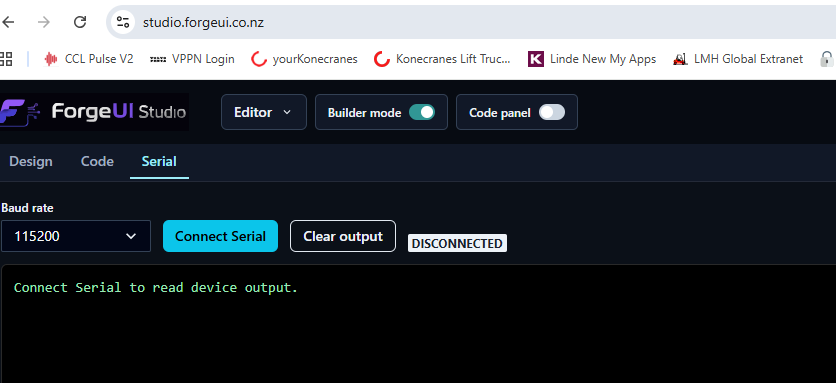
Move directly from flashing to live application output through the shared device session, with auto-scroll and a bounded output buffer.
Proven on physical hardware
Physically proven
Headless
Code/example → Hosted Build → Flash → Serial → real output
Physically proven
1024 × 600
Hybrid Design + Code → moving physical RPM gauge
Physically proven
1024 × 600
Mature Hybrid build, flash and display workflow
Physically proven
800 × 1280 portrait
Proven platform, build, flash and display workflows
Experimental registered profiles
Experimental: ESP32-S3 DevKitC-1 N16R8 · HW678 ESP32-S3 / SPARKE XH-S3E. Capabilities vary by profile; registration does not imply identical peripheral or display support.
Optional AI Layout Generator
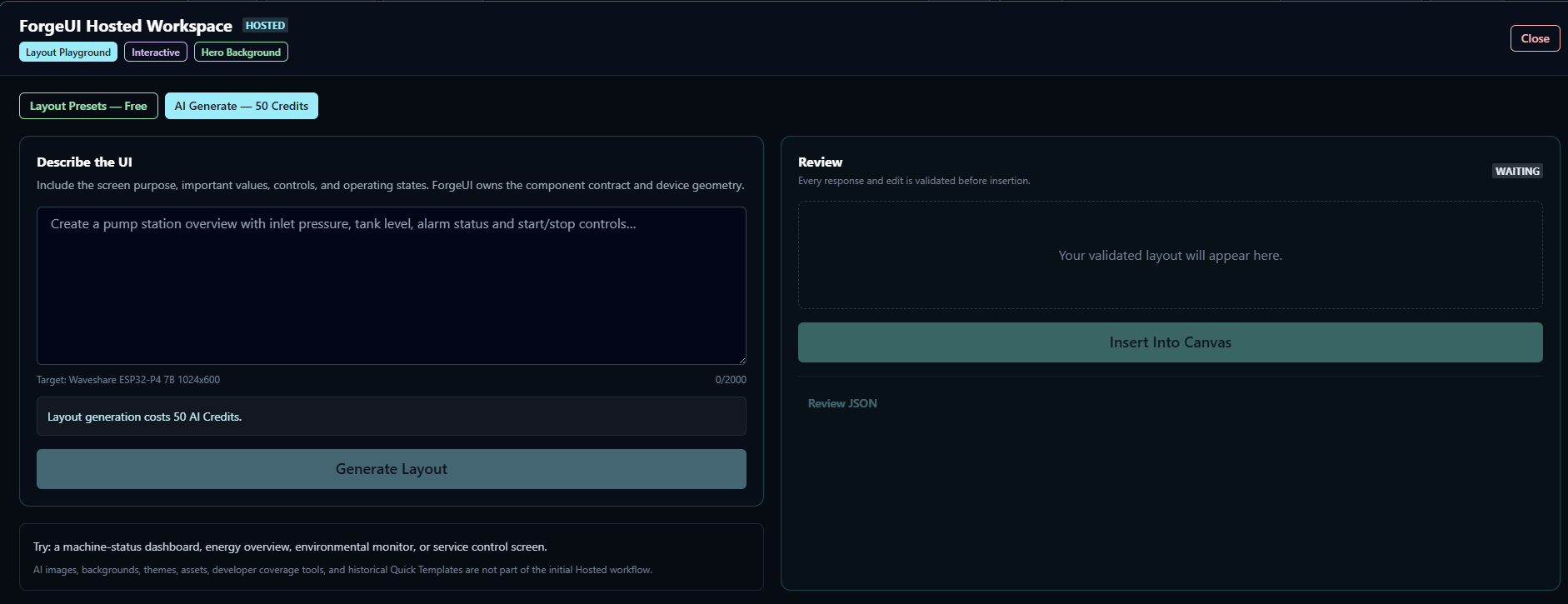
Generate structured, board-aware and palette/appearance-aware layouts constrained to supported components. ForgeUI validates geometry and repairs supported layout issues before you continue editing on the Canvas. Review generated results; automatic asset selection and complex-prompt results still have limits.
Questions
A browser-based visual and code development platform for supported ESP32 projects using ESP-IDF and LVGL.
Yes. ForgeUI generates native LVGL 9 interface code and a real firmware API from visual designs.
Yes. The Code workspace edits real ESP-IDF C source while protecting Studio-managed generated files from accidental changes.
Not for Hosted builds. ForgeUI Hosted Studio currently builds with ESP-IDF 5.5.4. Exported projects can also be developed locally.
Yes, for supported ESP32-S3 and ESP32-P4 targets in a compatible desktop browser using WebSerial.
Yes. Headless projects use Code → Build → Flash → Serial without the visual Design step.
Yes. The live library contains 20 searchable, categorized and board-aware examples. The expanded ESP-IDF set is currently focused primarily on ESP32-S3 Super Mini.
Yes. Hosted LVGL Simulator runs generated C with real LVGL 9.2.2 in WebAssembly, including native pointer interaction. Sim V1 covers UI behaviour; hardware services and custom C require target firmware.
No. Simulation uses a separate UI-only generation profile and preserves your saved hardware settings for Build & Flash.
Open source + Hosted
Public ForgeUI Studio and shared modules are open source under their applicable licences. ForgeUI Hosted provides the managed build and commercial service infrastructure. Third-party dependencies and examples retain their own licences and notices.
See the repository and website terms and notices for the applicable boundaries. Join the Facebook Community for projects and discussion.
ForgeUI Studio
Hosted Studio is free for personal and non-commercial use, with no time limit. Business / commercial use requires a Business licence. AI generation uses separate AI Credits.